
Questions, Intents, Decisions, Outcomes. Richard Brown, Pigraven LLC.
Running AI agents at scale is a management problem. The agents are fast, the technology exists, and the code is cheap. The humans are slow, expensive, and we unfortunately don’t contain the entirety of human knowledge in our frontal lobe… yet?
Every architecture problem in software is a communication problem. The tools a company runs on were built for people coordinating with people, at human scale, spread across many systems, each one pausing until someone answers. email, chat, tickets, pull requests, the prompt that asks “may I?”
Agents now pour work into those tools faster than people can turn it around. Anthropic hit the same wall in source control. Git was built for human-scale collaboration, so they moved the one thing agents must share, the branch heads, into a central store with compare-and-swap, and derived everything else from it. Product development needs the same move: the intents, decisions and outcomes that drive it, centralized at enterprise scale into one record that agents and people both read.
The QIDO model (say it “kee-doh”) is simple. Centralize the intents, decisions and outcomes, and expose a query language on top of that decision graph.
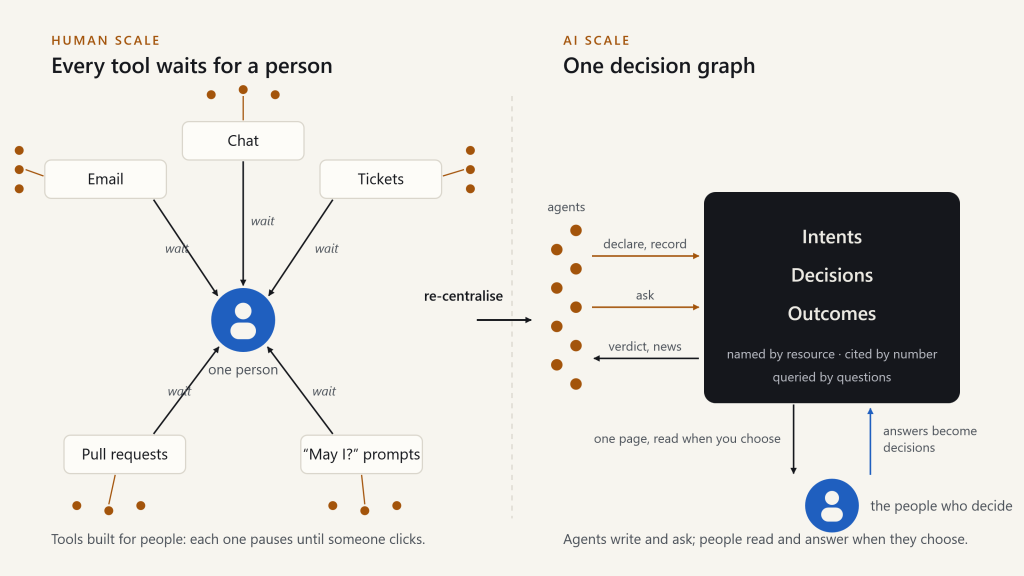
Figure 1. Left: every tool built for people waits on one person. Right: one decision graph that agents write to and query, and people read from one page.
The bottleneck is the decision
Three findings describe the situation:
- In LinearB’s benchmark of 8.1 million pull requests, agent-written ones waited about five times longer to be picked up than unassisted ones, 17.6 hours against 3.4 at the 75th percentile, and only 32.7% merged within 30 days against 84.4%. Once picked up they were reviewed faster. A review is a decision a person makes about an agent’s output, and that is where the wait is.
- When Anthropic measured engineers approving Claude Code’s permission prompts, the engineers approved 97% of them and caught a planted dangerous command 13.6% of the time, about 17% early in a session and about 5% after fifty prompts.
- Deloitte finds that 21% of firms have a governance model saying which decisions need human approval. In the other 79%, nobody has written it down.
A person’s attention, spent one decision at a time, is the scarce resource in a company that runs agents. A tool that pauses an agent until someone clicks treats it as free.
The model
QIDO is a decision graph. Its nodes are intents, decisions and outcomes; what links them is the resources they share, named in a vocabulary the business owns the way it owns a chart of accounts: a table, an API, an account, a customer, a document, a filing. Questions are how agents query it. The graph can start as a document, a numbered list of decisions, a list of checkpoints and a log of what agents set out to do and did; it needs software as soon as agents work in parallel, because a document does not reach an agent in the middle of its task.
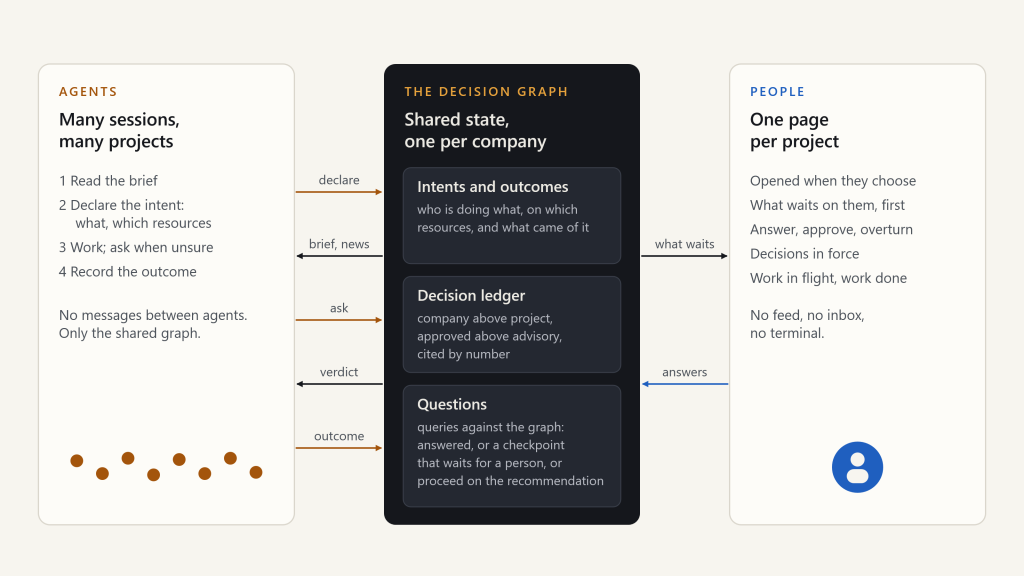
Figure 2. Agents and people never talk past each other: both touch only the graph. Agents declare, ask and record; people read what waits and answer, approve or overturn.
Intent. Before an agent changes anything, it declares what it is about to do, the resources it will touch, and the standing decisions it depends on. The declaration comes back with the overlaps: who else is working on those resources now. In one study of agents editing the same code at once, on constructed tasks, a single message about the concurrent change recovered 82% of the failures it caused; declaring before the change is how that message gets sent in time.
Question. A question is a query against the graph. The agent states the options, the one it recommends, the role that owns that kind of decision (a product manager owns scope, an engineer owns design, and so on; the business assigns the roles), and the resources the question is about. If a decision in scope already covers it, the graph answers, cited by number, and nobody is asked. If not, the graph settles one thing at once: whether this question stops work. The company, and each project within it, has written down what does. For a software company: money, anything sent or published outside the company, deleting content, production changes, legal or tax filings, and anything touching a client; a law firm’s or a clinic’s list will read differently. A question on that list is a checkpoint: the work that depends on it waits for a person, and the rest goes on. Any other question proceeds on the recommended option and stays open for the owning role to overturn.
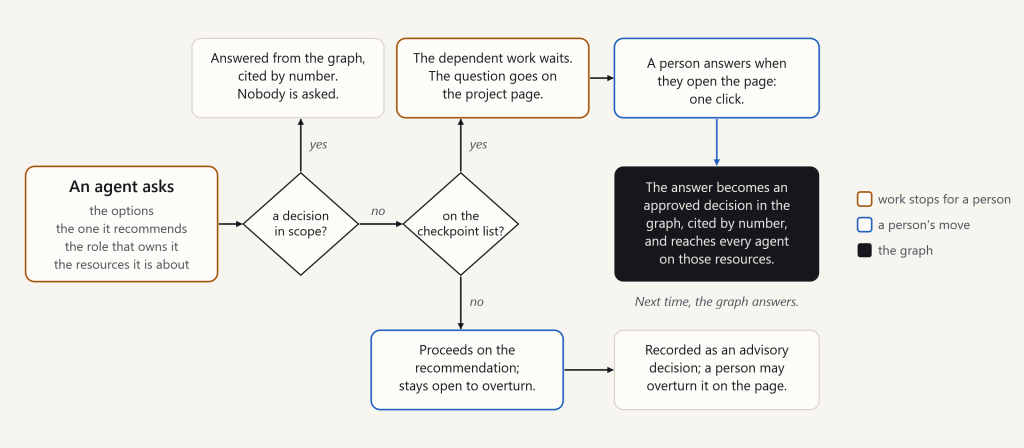
Figure 3. One question, three ways out: the graph already answers it, a person must answer it, or the agent proceeds on its recommendation. Every way out ends as a decision in the graph.
Decision. Decisions live in a ledger, each one a standing instruction with a scope, the whole company or one project, and the resources it concerns. Every decision is cited by number so that people and agents point at the same thing. A person’s answer to a question becomes an approved decision, and so does a refusal. A decision an agent makes is advisory: it goes on the project page for a person to approve or overturn, and other agents see it as advice in the meantime, not as a rule. Approved beats advisory, because an agent’s confidence is not evidence; in one study agents predicted success at 61 to 77% where the actual rate was 22 to 35%. Among approved decisions, company beats project, and a person’s decision is overturned only by a person, with a reason.
A decision is also a precedent, which is what the query is for: an agent that asks is answered from the graph when a decision in scope covers it, and a refusal recorded once is not asked for again by another agent. Precedents are evidence, not verdicts: in one preprint, a naive cache of past answers applied to look-alike requests was right about 58% of the time, and checking the match before reuse raised accuracy on a broader test from 70% to 84%, so an agent cites the decision it relies on by number and asks again when the scope does not match.
Outcome. Before an agent may stop, it records what it did and what is left, even when the answer is “nothing changed”. The steps in between stay in the agent’s own log and in the systems of record, the repository or the document.
Tooling holds the two ends: no change before an intent, no end before an outcome. Two rules hold the graph together. Agents coordinate only through it, never by messaging each other, so there is one place to look, nothing has happened in a private channel, and nothing one agent says to another counts as a person’s consent. And relevance is decided by names, not by judgement: news of an intent, an outcome or a decision reaches a working agent only where it touches or depends on the resources named, the answer to its own question always reaches it, and another agent’s question never interrupts it.
What management science already knew
Herbert Simon described an organization as a structure of decisions, and administration as setting the premises on which other people decide, so that they decide well without asking. Jay Galbraith described the organization as an information-processing system: the more uncertain the task, the more information has to move between people while the work is being done, and a firm either reduces that need or builds the channels that carry it. Henry Mintzberg listed the ways work is coordinated at all: people adjusting to each other as they go, a supervisor directing them, or standards set in advance for the work, its results, or the skills of those doing it. Direct supervision is bounded by how many one person can watch, which is why organizations move to standards as they grow, and the approval prompt that most agent tooling offers is direct supervision.
Put the three together and the shape of QIDO is already there. Decide the premises up front: a list of what stops work, and a ledger of standing decisions. Build the channel: one record that carries a decision from the agent that made it to the agents it affects, while they work. Set the standard: every agent reports the same two things, its intent before it starts and its outcome before it stops.
Other fields have run a few supervisors over many actors for decades, and their rules carry over almost unchanged.
- Armies brief by intent, “a clear, concise statement of the operation’s purpose and desired end state”, because no plan can account for every possibility: the decisions in scope are the agent’s brief.
- Air traffic control holds readback errors under one percent, and the fewest errors occur when a message carries one instruction element: an agent’s intent declaration is its readback of the task, one piece of work at a time.
Pigraven says
Human-scale infrastructure is not meeting the needs of AI. People are not scaling at the rate the work is changing, and asking them faster will not close the gap. Centralizing business decisions on the QIDO model is how an enterprise takes the scale AI offers and keeps hold of what it does: the decisions move to one place, the agents read them there, and the people who own them answer once.
Lightning is striking
Agents arrived faster than the infrastructure around them, and every company is deciding right now, prompt by prompt, what a person must decide. Decide it once instead. Write the list of what stops work this week. Number your decisions and keep them where every agent reads them. Make every agent declare before it acts and report when it is done. The companies that centralize their decisions now will run more agents than their competitors, with fewer people stuck in the queue.
Sources
- LinearB (2026), AI in software development benchmark (vendor): pickup time and 30-day merge rates for agent-authored pull requests.
- Anthropic (2026), on auto mode and permission prompts in Claude Code (vendor study): 97% approval rate; 13.6% detection of a planted dangerous command.
- Anthropic (2026), Redesigning source control for the age of agents: refs as the one shared mutable state, moved to a central compare-and-swap store.
- Deloitte Insights, on AI agents and governance: 21% of firms with a governance model naming the decisions that need human approval.
- Herbert A. Simon, Administrative Behavior (1947).
- Jay R. Galbraith, “Organization Design: An Information Processing View”, Interfaces (1974); at length in Designing Complex Organizations (1973).
- Henry Mintzberg, The Structuring of Organizations (1979).
- US Army, Understanding mission command: commander’s intent.
- O. V. Prinzo (2008), on readback errors in air traffic control.
- Google, Site Reliability Engineering, “Being on-call”.
- Ruff et al., on management by consent and by exception in the supervisory control of several unmanned vehicles.
- Parasuraman and Manzey, Complacency and Bias in Human Use of Automation: An Attentional Integration (2010).
- PagerDuty, Reduce noise (vendor guide).
- arXiv 2609.25396 (2026), on interference between concurrent coding agents and recovery from one message about the concurrent change.
- Kaddour et al., arXiv 2602.06948 (2026), on agents’ predicted against actual success rates.
- AgentTrust, arXiv 2606.08539 (2026 preprint), on the accuracy of cached verdicts.